Safety Message from BC Hydro
Purpose
Every fall and winter BC Hydro sees an increase in motor vehicle accidents and incidents involving trees, and we would like to remind first responders of the need to watch for electrical hazards when responding to these events.
When vehicles and trees contact powerlines they often pull the wires away from their insulators. The wires can now hang within reach and energize anything they are in contact with – even a power pole. Often there are no obvious signs that electricity is present, but first responders and the public may be exposed to the hazards of touch potential and step potential.
Definitions
Touch potential refers to the fact that electricity is always looking for a path to ground. When someone touches energized equipment, their body can become part of that path.
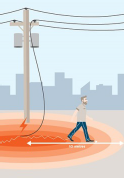
Step potential takes place when a conductor, such as an energized wire, pole, tree, or vehicle, touches the ground. Voltage is the difference in electric potential between two points and in this case one point is where a line energized at 14,400V touches the ground, and another point is 10m away where the voltage is zero. A gradient is established between these points and if someone was to walk across the gradient, away from or toward the conductor, they could be exposed to thousands of volts at each step. We recommend that people identify the possibility of step potential and shuffle, heel to toe, until they are 10m away.
Messaging
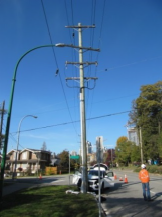
BC Hydro crews responded to an incident recently where a vehicle had struck and damaged a pole, pulling two wires away from their insulators. One wire was resting on the cross arm, energizing the pole, and the other wire was resting on a metal street light, energizing it as well. Electricity was flowing down the two poles, creating a touch potential hazard. When the BC Hydro crew approached they used a voltage detection tool and were able to measure the ground gradient caused by the electricity flowing into the ground, a step potential hazard.
First responders should also be aware that even when the relays and breakers have operated correctly to identify and clear the fault, a line may remain energized due to induction from parallel lines. It may also be re-energized at any moment due to system reconfiguration or backfeed from portable generation.
Always maintain a safe distance from electrical lines and equipment until a BC Hydro worker has attended and told you that it is safe to approach. BC Hydro workers will immobilize devices to create a safe work zone. They will test for voltage and apply equipotential bonding and grounding to negate the effects of induction, remote energization, and portable generation. BC Hydro workers would never make assumptions about whether a line is safe…..neither should you!
References
We encourage all first responders to take advantage of BC Hydro Electrical Safety Awareness training. It is free and available online or in person at bchydro.com/safetytraining. And if you have questions or comments on electrical safety and BC Hydro, please contact Marc Spencer in BC Hydro Public Safety at (604) 528-1952.
Review Schedule
| Adopted | Next Review Scheduled | Owner | Reviewer |
|---|---|---|---|
| Dec 2024 | Mar 2025 | Clinical Hub Mnager | BCEHS OHS Team |